Forged automotive components refer to strong vehicle parts which get produced by changing heated metal under planned pressure to provide better performance. The main reason why forged automotive components are used is their light weight which makes them more usable in different cars. Moreover, special manufacturers of forged automotive components are set to create the needed products, taking into account different performance and safety characteristics. When evaluating different manufacturers, one should consider technics used for forging, as well as materials quality, presence of various documents, accuracy of dimensions, features of testing, production capabilities, experience in the industry, and references from customers.
Forged Automotive Components in India: Top Companies, Examples & Global Demand
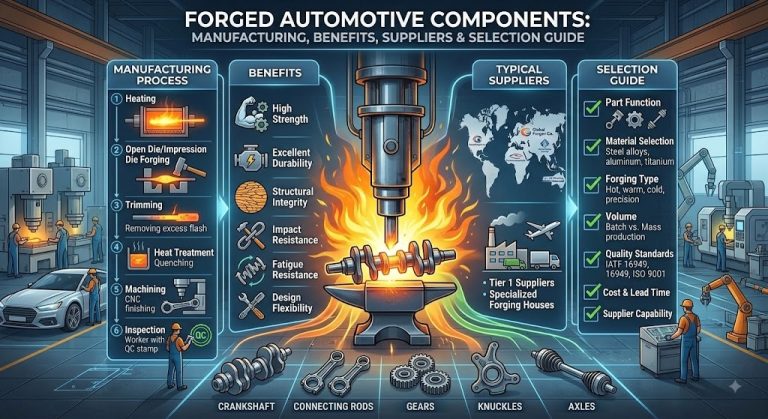
By checking the business directories directory websites, listings for forged automotive parts can be downloaded such as Google Business, Google Maps, Bing Business Directory, Indiamart, Just Dial, however, the top 10 companies that manufacture forged components include Sendura, Bharat forge, Ramkrishna forgings, super auto industries, Taj industries, Indigo Technologies, Stefaco industries, Radhe forged products, Pushti Metal Industries and Bomrah industries. Common types of forged automotive components include crankshafts, connecting rods, steering arms, axle beams, wheel hubs, transmission parts and gears, shafts, suspension components, engine components. It is important to understand that crankshafts, connecting rods, axle components, transmission components and suspension components are the most widely forged parts throughout the globe due to their resistance to high pressure and toughness.
Forged Automotive Components Manufacturing: Processes, Tools & Latest Technologies
Forged automotive components are produced from metal billets or blanks by heating them and shaping with specific pressure as per requirement, afterwards trimming, heat treatment, machining, and quality testing are carried out. Manufacturers use forging dies, presses, hammers, CNC machines, trimming tools, heat-treatment equipment, measuring instruments, and non-destructive testing systems. Open-die forging, closed-die forging, impression-die forging, drop forging, press forging, and precision forging are the commonly used forging techniques. Manufacturers are utilizing different technologies for improving their production processes as well as enhancing their productivity, precision of dimensions, consistency of products, automation, quality, and competitiveness in international markets.
Government Initiatives, Foreign Investment & Production Growth in India’s Forged Automotive Sector
To attract foreign direct investment, India is implementing several steps, such as the production-linked incentives, automotive manufacturing policy, infrastructure development, and measures that enhance the ease of doing business in India. Government schemes and initiatives to support automotive manufacturing enhance technology upgrades, exports, skill development initiatives, and domestic supply chain support that can help make the automotive forged components industry stronger in India. Enhancing production capacity will improve manufacturing output as well as create more jobs and generate more investments, which will benefit the automotive supply chain and contribute to the general economic growth of India.
Looking for High-Quality Forged Automotive Components?
Discover reliable forged automotive components designed for strength, durability, precision, and safer vehicle performance. Connect with an experienced forging manufacturer for your component requirements.
Explore Forged ComponentsGet reliable forging solutions for automotive and industrial applications.
Conclusion
The automotive industry relies heavily on forged components for their strength, durability, fatigue resistance, and reliability in crucial automotive applications. With the current level of technology, India stands at a major advantage with respect to its potential as a supplier due to the number of steps that can take place within its territory, such as enhancing capacity, modernization of forging techniques, improving quality of production, and skilled labor. With the help of various government incentives including subsidies, infrastructure improvement, technological advancement, export promotion, stronger development of the sector is possible. Finally, buyers should analyze forged component producers properly by taking into account the number of options including certification, performance history, available technologies, testing facilities, and product rates.