Lately, I had the opportunity to inspect the shop floor of a major automotive manufacturer’s facility in downtown Stuttgart. The purchasing head, having pointed a large, heavy-duty, closed-die forged crankshaft at me that was still waiting on its pallet to be loaded, asked very seriously: “We would never dare source crankshafts from South Asia 5 years ago. However, right now, components made in India’s Maharashtra State are clearly outperforming the domestic ones in our company for both microstructural integrity and dimensional precision.”
This moment was quite enlightening for me. It was not only the gain of one plant; rather, it marked a massive change in perception of international purchasing leaders regarding the heavy engineering products made by India.
Sourcing leaders from abroad typically took a critical look at potential hubs of low-cost manufacturing: Could they grow and scale? Did they have the mindset necessary for the zero-defect philosophy? Would their engineers be able to detect slight porosity problems before sending the entire batch out of a country by sea container?
Today, the above issues are no longer relevant.
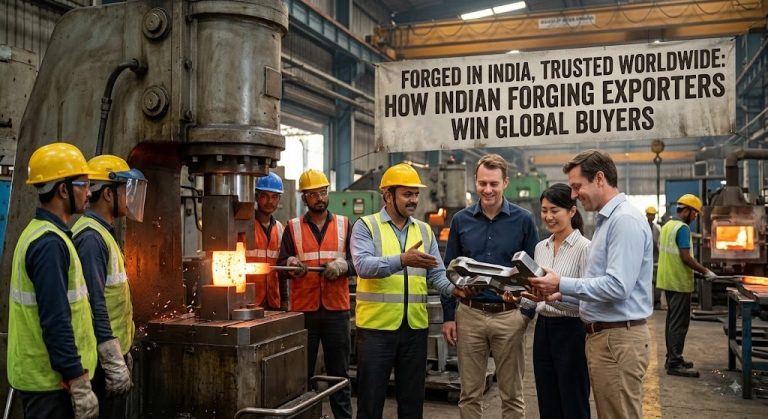
Some Forging Exporters India are among the best in the whole industry, and not just as a cost-cutting measure. They obtain contracts from the top OEMs in countries such as Canada, the USA, the Middle East, etc., by producing extremely safe and precise forged components, which fully satisfy the ISO/TS and IATF 16949 standards.
This content could help any international procurement manager, supply chain director, or chief engineer looking to secure their supply of parts by selecting, inspecting, and forming collaborations with India’s forging manufacturers.
Paradigm shift: Why foreign original equipment manufacturers are going back to India for re-designing the supply chain
A brief history of global supply chains in the second half of the 2020s will probably include the words ‘supply chain’, ‘geopolitical tensions’, and ‘energy crisis’. All these factors have pushed procurement leaders to take another look at their vendor networks. Still, strategic supplier diversification is only possible in a market that is characterized by stable and developed manufacturing capabilities.
Besides, the Indian forging industry is an exception here as it has grown considerably over the years in terms of technical expertise.
India’s contribution to forging has mainly come through international exports as well as the development of local industries.
India has grown to become one of the top global metal-forming centers thanks to its low-cost and efficient production capabilities and the availability of raw materials such as iron and steel. These are further complemented by its large population and young workforce.
India’s steel and metallurgy sectors are a crucial part of the country’s economy.
Moving forward, the major factors for such change are:
- Raw Material Traceability: It has become the standard among all big Indian furnaces and forging centers to directly get their primary steel from big steel plants like Tata Steel, JSPL, or Kalyani Steels, for example, with the help of full traceability and no contamination by scrap.
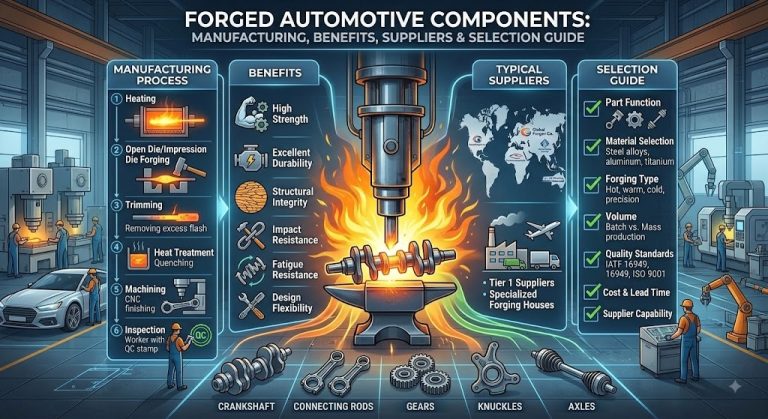
- Investment in Large-Capacity Forging Equipment: The Indian plants are equipped with modern forging technologies ranging from small 1000-ton drop-forging machines of medium scale to 16, 000-ton fully automated hot forging closed-die machines, enabling production of anything from small precision parts of 0.5 kg (0.5 kg precision gears) up to relatively big flange-type ones of 800 kg.
- Production of Finely Finished Components: The time when customers could expect to receive unfinished forgings which would then need to be machined after arriving at the destination port is over. At Indian facilities, it is now the norm to have CNC/VMC machining work areas, heat-treatment rooms and surface finishing machines all within a single manufacturing complex.
Technical excellence: Understanding the metallurgical prowess of Indian forging
When looking for high-end parts like powertrain components for off-highway machines, underground oil rig valves, or landing gear parts for commercial airplanes, it is impossible to afford failure. Indian forging plants are trusted globally for their expertise mainly because they always take grain-flow optimization as the major point.
Compared to casting parts, which tend to develop shrinkage cavities and internal micro-voids, high-precision metal forging not only makes the material’s grain structure more resistant to damage but also ensures it aligns with stress directions.
A key step for procurement teams in evaluating an Indian Forging Exporter is to verify the supplier’s handling of metallurgical changes in three main areas:
1. Material Selection and Alloy Capabilities
Forge shops in India use different types of ferrous and non-ferrous metals that range from very basic to the most complex:
- Carbon and Alloy Steels: (e.g., 20MnCr5, 4140, 4340, EN9, EN19, EN24)
- Stainless Steels: (Austenitic, Martensitic, Duplex, and Super Duplex grades like F316L, F51, F53) are essential for valves, flanges, and other marine hardware in the oil & gas industry that are subject to corrosion in the extreme.
If you are looking for parts made out of these, such as valves for oil & gas pipelines, petrochemical flanges, and the hardware to be used underwater will last very long thanks to stainless steel that is highly resistant to corrosion.
- Non-ferrous Alloys: (Aluminum 6061/7075 and Titanium grades) These are the segments with the fastest growth, driven by aircraft structural items and by the demand for lightweighting electric vehicles.
2. Controlled Heat Treatment Cycles
Forging is only the beginning; it’s through the thermal profile that the final mechanical properties will be defined. Leading exporting companies have totally automatic, furnace-connected heat treatment systems which allow them to control various heat treatments:
- Normalizing & annealing for reducing residual stresses and refining grains to a uniform state.
- Quenching & tempering (Q&T), which is used to obtain a specific hardness (Rockwell/Brinell scale hardness) and impact energy value (Charpy V-notch testing at sub-zero temperatures).
- Case hardening and carburizing give the surface high resistance, while the core remains tough and malleable.
3. Precision Die Engineering & Simulation
Furnishers from India now have the modern equipment to make use of finite element analysis (FEA) software such as DEFORM or FORGE to see through the metal flow and heat transfer before going to the tool cutting stage. This not only avoids die-fill errors and lap defects but also flash waste in a very drastic way to reduce the time for tooling development for a custom OEM drawing.
How Leading Indian Exporters Stack on Core Operational Metrics
One of the biggest challenges in selecting Forging Exporters in India is the trade-off between component weight, minimum quantities that a supplier will handle, the tolerance you can expect as a result of the production process, and the standards you must comply with.
| Operational Parameter | Tier-1 Enterprise Exporters | Mid-Market Precision Specialists | Agile Niche & SME Forgers |
| Primary Focus | High-volume Automotive, Aerospace, & Defense | Heavy Machinery, Valves, Energy, & Hydraulics | Custom Shafts, Rings, & Small-Batch Prototypes |
| Forging Techniques | Closed-die, Impression-die, High-Speed Press Lines | Open-die, Rolled Ring, Closed-die Hot Forging | Open-die Hammer, Free-forging, Batch Hot Pressing |
| Weight Capability | 0.2 kg up to 500 kg+ | 1.0 kg up to 5,000 kg (Ring/Open-die) | 0.5 kg up to 100 kg |
| Machining Readiness | Fully finished, assembled sub-components | Semi-finished to Turnkey CNC Machined | Rough-machined or Proof-machined |
| Quality Certifications | IATF 16949, AS9100D, ISO 14001, ISO 45001 | ISO 9001, PED 2014/68/EU, API 6A/6D, NORSOK | ISO 9001:2015 |
| Lead Time (Tooling) | 6 to 10 Weeks | 4 to 6 Weeks | 2 to 4 Weeks |
Audit Process for Selecting a Forging Manufacturer on The Premises of the Forging Company in India
Look! Anybody can send a beautiful corporate PowerPoint slideshow showing clean factory floors. However, when millions of dollars are at stake in terms of supply chain continuity, buyer procurement teams will need a robust, battle-tested vetting protocol that they have never regretted.
Use the following list step-by-step to inspect Forging Exporters India before you send the first RFQ (Request for Quotation).
- Checking Raw Material Sourcing & Mill Certification is vital for chemical and mechanical consistency.
Ask for material certificates and test results (MTCs) that comply with EN 10204 Type 3.1/3.2. Double-check that the supplier only sources billets from ISO-certified primary steelmakers who also have ladle facilities (LF/VD/ESR). Ensure that every delivery batch of billets is validated spectrographically.
- Audit of Die In-House Design & Toolroom: It is related to the rate of turnaround of the prototyping and also determining the consistency of the parts.
Investigate that the factory is equipped with a few of the fast 3- and 5-axis CNC machines for die-sinking. Obtain proof that they also have the software for process simulation (like DEFORM), so as to check if their methods avoid cold shut, unfilled corner, and excessive die wear, and that at least for the trial run volumes.
- Examination of Non-Destructive Testing (NDT) & Quality Assurance: It will result in defect-free overseas shipments.
Confirm availability of their NDT (Non-Destructive Testing) facilities in-house. As per your site survey report, you shall be assured of the presence of Level II/III ASNT-trained staff who have performed the following tasks:
- UT (Ultrasonic Testing) for detecting voids within the material.
- MPI or LPT (Magnetic Particle Inspection or Liquid Penetrant Testing) to identify cracks on or below surfaces.
- CMM (Coordinate Measuring Machine) in climate-controlled rooms for checking the key dimensions.
- Heat Treatment & Microstructural Test: The parts will retain their physical properties even after mechanical failure.
Go through furnace calibration records (complying with API6A Annex F or CQI-9 standards). Ask to see micrograin analysis results, microhardness mapping reports, and impact testing results as proof to you that all heat-treated parts were uniform.
- Shipping & Packaging Policies Worldwide: Avoid shipping rust, damage, or port delays.
Find out the way their export packing is done. Very important to treat components with VCI (Volatile Corrosion Inhibitor) oil, then wrapped in anti-corrosive barrier bags, placed in sea-worthy IP15-compliant wooden cases made to survive long-distance freight.
Removing the Barriers of Worldwide Sourcing: Quality Assurance, Regulatory and Risk Aspects
We might as well admit: there are risks in international buying. In fact, it seems that whenever an international buyer works with an Indian supplier, one of her three main sources of friction in day-to-day operations is:
1. How to prevent deviations from required sizes in a lot of items produced one after another?
Leading Indian forging companies have Statistical Process Control (SPC) systems connected to automated inline gauging units as well as CMM. These systems work in real time to automatically adjust the CNC offsets, and hence, they ensure the dimensional accuracy of the important areas within +/-0.02 mm even over tens of thousands of runs.
Major Tip: Ask your supplier for the presentation of Initial Sample Inspection Reports (ISIR) together with the completed Production Part Approval Process (PPAP Level 3) documents before authorizing mass production runs.
2. Are we compliant with all environmental and ethical aspects of international regulations?
Around of top quality of Forging Exporters India work under ESG frameworks strictly. Most facilities are powered by rooftop solar arrays and have a closed-loop water recovery system. These export-focused companies now routinely do the tracking of compliance for REACH, RoHS, Conflict Mineral Mandates, and even the EU Carbon Border Adjustment Mechanism (CBAM).
3.”How to manage supply chain breaks or shipping blockages?”
Top-tier suppliers usually have reserves of inventory in the form of managed inventory stock (VMI) or safety stocks at warehouses near the main destination ports, such as Rotterdam, Houston, and Hamburg. Also, the development of India’s coastwise port infrastructure (as per national maritime modernization programs) has facilitated shorter waiting times of ships at such exporting hubs as JNPT (Mumbai), Mundra, and Chennai.
Procurement Leaders: How to Move Forward Strategically
Getting forged metal parts is not merely the case of one-time purchase but rather a continuous risk management exercise. The emergence of capable Indian forging exporters offers world procurement people a convincing alternative, combining the traditional metal processing knowledge with the advanced manufacturing facilities.
Full raw material traceability insistence, the verification of NDT and machining on the premises, and setting up strict PPAP approval procedures can enable international buyers to create robust and economically optimized supply chains that can be relied upon in the long run.
The Indian forge manufacturers are not merely responding to orders but also participating in the development of the highly stressed mechanical systems of the future.