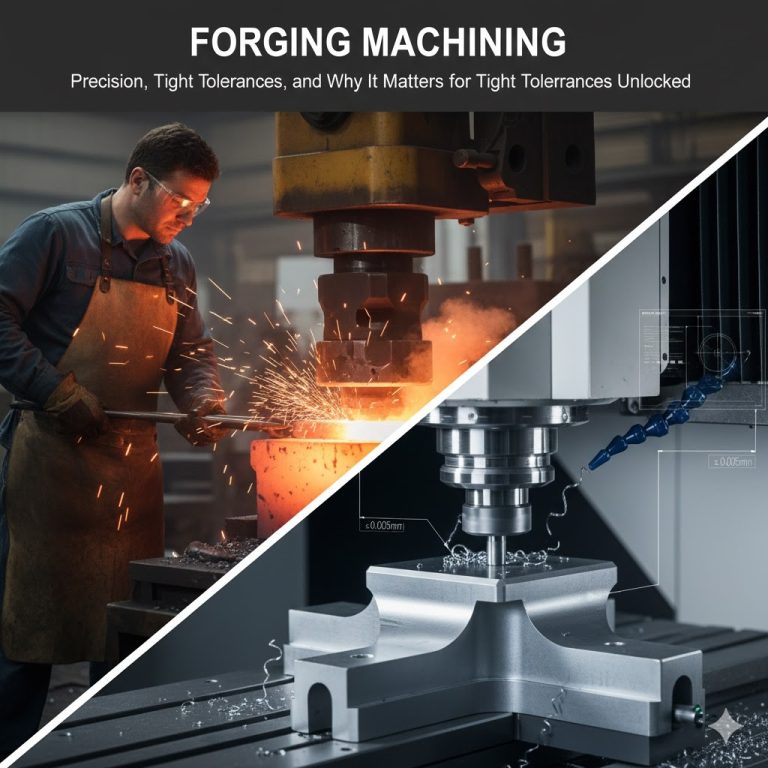
Precision does not begin at the CNC machine. Precision begins when metal is first forced into shape. Many tolerance failures blamed on machining originate much earlier—inside the material itself. Distortion after heat treatment, dimensional drift during service, and unpredictable alignment issues often trace back to poor structural preparation. Forging machining exists to close that gap between strength and accuracy, not by adding more inspection, but by fixing the root cause.
Tight tolerances survive only when structure supports them.
Forging Machining Is a Manufacturing Logic, not a Process Label
Forging machining is often misunderstood as forging followed by machining. That interpretation misses the point.
Forging machining is an integrated manufacturing logic where forging geometry, grain flow, machining allowances, and datum strategy are decided together. Forging creates a structurally stable blank. Machining refines only what must be refined. No step exists to correct mistakes made earlier.
When forging and machining operate in isolation, tolerances look correct on inspection reports and fail in service. Forging machining avoids that disconnect.
Why Machining Alone Cannot Hold Tight Tolerances
Machining removes material. Machining does not reorganize metal.
Raw stock and poorly forged blanks contain internal stress, uneven grain distribution, and density variation. During machining, those hidden conditions release energy. Bores shift. Faces warp. Concentricity drifts. Dimensional accuracy disappears after heat treatment or assembly.
Tight tolerances require dimensional stability, not just dimensional accuracy. Forging machining delivers stability by preparing metal before cutting begins.
Grain Flow Control: The Hidden Driver of Precision
Forging forces metal to flow along geometry. Grain direction follows load paths, bores, hubs, and transitions.
Aligned grain flow stabilizes cutting behavior. Tool pressure remains consistent. Heat distribution stays uniform. Surface finish improves. Dimensional scatter narrows. These effects compound across production volumes.
Machining across random grain orientation increases chatter, tool wear, and unpredictable deflection. Forging fixes those variables early. That structural order is the quiet reason forging machining performs better in high-precision environments.
Residual Stress Starts Before the First Cut
Residual stress is not created by machining alone. Residual stress is inherited.
Forging under controlled deformation reduces internal stress by consolidating material uniformly. Heat treatment further equalizes structure. Machining then removes material symmetrically, preserving balance.
Without forging control, machining releases trapped stress unevenly. Parts pass inspection and fail later. Forging machining treats stress as a system variable, not a downstream problem.
Near-Net Forging Changes the Tolerance Equation
Near-net forging reduces machining depth. That reduction matters.
Less cutting means less heat input, less stress imbalance, and fewer opportunities for distortion. Functional geometry is established during forging, not corrected afterward. Machining becomes refinement, not rescue.
This approach supports flatness, concentricity, and parallelism requirements that brute-force machining struggles to maintain. Forging machining benefits most when forging shape already respects functional intent.
Tight Tolerances That Must Survive Heat and Load
Inspection-room tolerances mean little if geometry moves during service.
Forged-and-machined components retain accuracy after heat treatment because internal structure supports dimensional stability. Load application does not rearrange grain boundaries. Thermal cycles do not trigger creep-driven distortion.
Shaft alignment, bearing fits, sealing faces, and gear interfaces rely on this stability. Forging machining protects tolerances beyond production and into operation.
Process Stability and Tool Life Benefits
Consistent material behavior improves machining outcomes.
Forged blanks present uniform hardness and predictable cutting response. Tool wear stabilizes. Feed rates remain consistent. Scrap drops. Statistical process control tightens.
Machining variability often traces back to inconsistent material. Forging removes that uncertainty. Forging machining turns precision from an exception into a repeatable outcome.
Where Forging Machining Becomes Non-Negotiable
Certain applications demand tolerance retention under stress:
| Requirement Area | Conventional Machining | Forging Machining |
| Heat-treated dimensional stability | Uncertain | Predictable |
| Long-length concentricity | Difficult to retain | Structurally supported |
| Flatness under bolt preload | Prone to relaxation | Stable |
| Fatigue-loaded accuracy | Gradual drift | Long-term retention |
| Assembly alignment | Adjustment-heavy | First-fit accuracy |
In these conditions, forging machining is not optimization. It is risk control.
Design Decisions That Decide Tolerance Success
Tolerance performance begins in design.
Forging-aware design places fillets where metal flow strengthens structure. Machining allowances remain uniform. Datum selection reflects forged geometry rather than raw stock assumptions. Transitions support load instead of concentrating stress.
When design ignores forging behavior, machining compensates until tolerance limits collapse. Forging machining succeeds only when design, forging, and machining operate as one system.
Sendura Forge Pvt. Ltd work within this integrated framework, aligning die design, forging flow, and machining strategy to protect dimensional intent from the first operation onward.
Inspection Confidence Comes from Structural Uniformity
Measurement reliability depends on stability.
Forged-and-machined parts hold shape during inspection. Non-destructive testing produces cleaner signals due to uniform density. Repeat measurements agree. Assembly results remain consistent.
Unstable material undermines inspection credibility. Forging machining restores trust between measurement and reality.
Cost Control Through Fewer Corrections
Precision achieved repeatedly costs more than precision achieved once.
Corrective machining, stress relief cycles, rework, and scrap inflate cost quietly. Forging machining reduces these losses by eliminating instability early. Planning effort increases. Downstream waste decreases.
For tight-tolerance components produced at scale, forging machining controls cost by controlling behavior.
Tolerance Stack-Up Control Starts at the Forging Stage
Tolerance stack-up is rarely a machining problem. It is a geometry inheritance problem.
Every forged surface becomes a reference—either directly or indirectly—for later machining operations. When forged geometry lacks symmetry, consistent wall thickness, or predictable draft behavior, machining datums drift. That drift compounds across operations. Each cut remains “within tolerance,” yet the final assembly fails.
Forging machining prevents stack-up failure by anchoring all downstream dimensions to stable forged features. Boss locations, hub centers, and critical planes are forged with intent, not approximation. Machining then references those forged features instead of fighting them.
This approach sharply reduces cumulative error across multi-operation parts. Coaxiality holds because centers originate from forged mass balance. Parallelism survives because reference faces are not stress-biased. Hole true position remains consistent because material flow supports the geometry being measured.
In tolerance-critical assemblies—where multiple parts interact simultaneously—this control is decisive. forging machining transforms tolerances from isolated limits into a coherent dimensional system, where each feature reinforces the next instead of undermining it.
Conclusion
Tight tolerances do not survive on drawings alone. Survival depends on structural order, stress balance, and predictable material response.
Forging machining matters because it builds precision into the metal before cutting begins. Forging provides stability. Machining provides accuracy. Together, both deliver components that remain true under heat, load, and time. Where tolerances must endure rather than merely pass inspection, forging machining becomes the only approach that actually works.