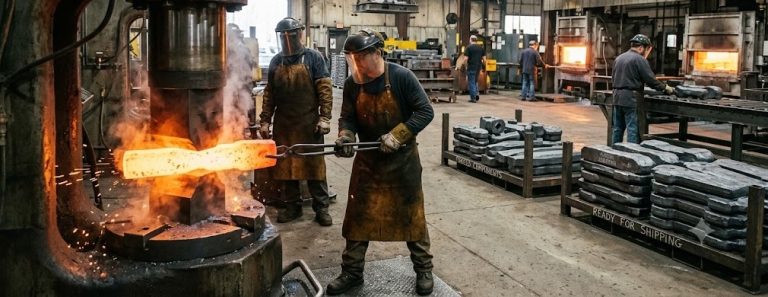
Metals are hard, solid and strong and shaping them to definite shapes and complicated geometrical designs can be difficult. However, with precision engineering we can make use of precision forging techniques that allows us to perform forging tasks with 100% dimensional accuracy. The cost of the forging is minimized as metal forging suppliers make use of modern forging machines that consumes less electricity and is capable of scaling the production at the time of need. The demand for metal forged components or parts are increasing every year globally. That is why metal forging suppliers need to make sure that they have surplus forged components so that they do not go out of stock.
Modern machines used by Metal forging suppliers
The modern metal forging industry has adopted various equipment and machinery to ensure high accuracy and quality of forged products. Hydraulic press machines are specially designed to produce forged parts by exerting precise forces to ensure accurate bending and forming of metal parts, while mechanical press machines facilitate fast press forging giving way to mass production of complex forged articles. Press breaking machinery helps in accurately shaping of metal sheets and items in respect of dimensions to suit various needs of production, thus maintaining uniformity in production lots. For the purposes of cutting raw materials before forging, CNC hydraulic shearing machines are used to ensure accurate cutting of sheets, thus minimizing any wastage of material. The combination of all these machines increases efficiency of manufacturing and results in better quality of products and higher compliance with international standards.
How metal forging supplier is revolutionized with cutting edge technologies?
The upheaval of metal forging suppliers is brought about by cutting-edge technologies that increase production accuracy, efficiency, and quality of products. The use of CNC-controlled forging equipment, automated material handling, robotics, and computer-aided design and manufacturing (CAD/CAM) technologies have resulted in increased accuracy and reliability of production processes. There are modern simulation technologies also that allow optimizing various aspects of die design and forgings in the pre-production stage. By doing so manufacturers may avoid unnecessary material wasting and hasten the development process. Moreover, process monitoring, IIoT sensors implementation, AI-based quality control, and predictive maintenance systems further help in securing consistent quality of products and reducing the operational costs at the same time. Thus, the whole process allows meeting the high standards of production quality of metal forging suppliers and their customers.
Conclusion
Metal forging suppliers are very important in sustaining modern industries, since they provide high-quality and engineered forgings for various applications. Thus, thanks to the usage of contemporary forging machines, fully automated production lines, and up-to-date information technologies, metal forging suppliers produce durable and reliable forgings with both high dimensional accuracy and constant quality in their manufacture. They keep investing in innovations, quality control, and sustainable production in order to meet rising global demands and to keep abreast with industrial demands across the world. Therefore, it is not an exaggeration to say that metal forging suppliers will remain of great importance for industrial development by being the customers of different industries.