Industrial machines do not fail because they are old. They fail because something inside them gives up. Bearings crack. Shafts twist. Arms fatigue. Joints loosen. And in most cases, the root cause traces back to the same place: the quality and structure of the components carrying the load.
This is where forging components separate themselves from everything else. Not on paper. Not in brochures. On the shop floor. In heat. In dust. In vibration. In the kind of abuse that never appears in design simulations.
Forging is not just a manufacturing method. It is a structural decision.
Internal Structure That Refuses to Break
Every metal part has a grain. How that grain is arranged decides whether the part survives or surrenders.
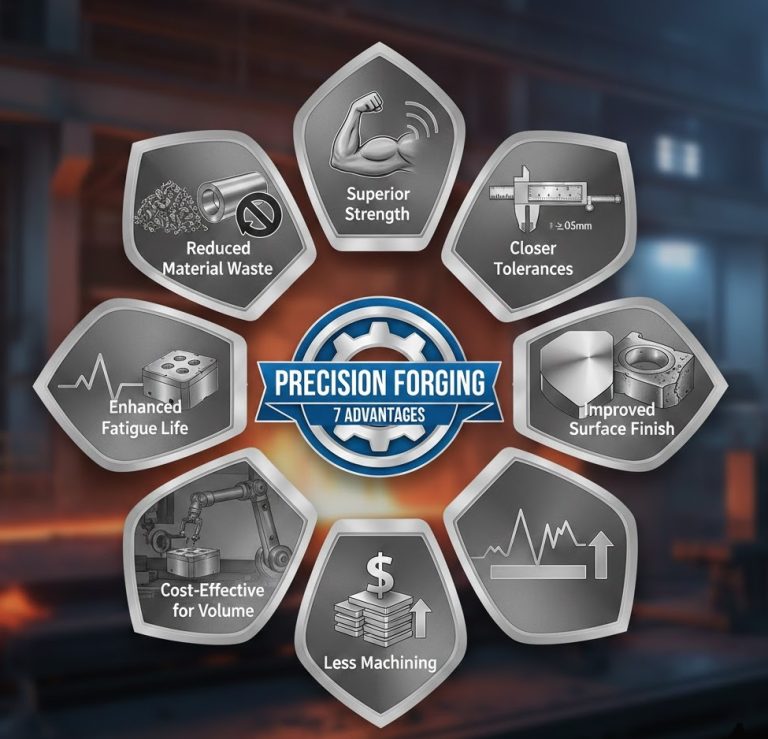
Forging reshapes metal while it is hot and plastic. The grain is not cut. It is bent. Flowed. Directed. It follows the contour of the part like wood grain follows a branch. That alignment matters. When load hits the part, the force travels along the grain instead of across it. Cracks do not get easy entry. Stress does not pile up in one weak zone.
Cast parts do not have this advantage. Machined parts lose it. Forged parts keep it.
This is the single biggest reason forging components stay alive when others start failing.
Fatigue Resistance That Actually Shows Up in Service
Fatigue is not dramatic. It is slow. Quiet. Relentless.
A component may look perfect from the outside while the inside is breaking down, cycle by cycle. That is how shafts snap without warning. That is how arms fracture in the middle of a shift.
Forged metal resists this process because the structure is continuous. No internal voids. No random grain boundaries. No hidden pockets waiting to become cracks.
In rotating equipment, in presses, in conveyors, in crushers, this resistance is not optional. It is survival.
This is why forging components are standard in high-cycle environments where replacement is expensive and failure is unacceptable.
Impact Strength That Saves Equipment from Sudden Death
Real machines do not run in perfect conditions.
Material jams. Operators make mistakes. Loads shift. Terrain changes. Systems shock. That is reality.
When sudden force hits a brittle part, it breaks. When it hits a forged part, it is absorbed.
Forged metal has higher toughness. It deforms before it fractures. It spreads energy instead of concentrating it. This is the difference between a machine stopping and a machine being destroyed.
In lifting equipment, transport systems, heavy frames, and structural assemblies, forging components are trusted because they do not panic under pressure.
They hold.
Dimensional Stability That Keeps Assemblies Aligned
Misalignment kills equipment quietly.
Bearings wear unevenly. Seals start leaking. Gears begin to sing. Then grind. Then fail.
Forged parts stay in shape. The internal structure is balanced. Residual stresses are lower. Heat treatment locks the geometry in place.
When temperature rises, the part expands evenly. When it cools, it contracts evenly. No warping. No creeping. No slow distortion.
This stability protects everything connected to it. Shafts stay straight. Housings stay true. Assemblies stay aligned.
Long life is not only about strength. It is about staying where the design intended.
Wear Resistance That Reduces Replacement Cycles
Wear does not announce itself. It steals life quietly.
Forged metal has density. The surface is tighter. The structure underneath supports it. This makes forged parts harder to erode, harder to score, harder to eat away.
Pins last longer. Bushings stay round. Flanges keep their faces. Couplings keep their teeth.
Using forging components in high-wear zones is not a luxury. It is basic risk control.
Fewer replacements. Fewer shutdowns. Fewer emergencies.
Load Paths That Make Mechanical Sense
Forging allows metal to be shaped along the path of force. Not against it.
Curves instead of corners. Transitions instead of steps. Flow instead of interruption.
Stress does not like sudden changes. It piles up. That is where cracks start. Forged geometry smooths these transitions, spreading load naturally through the body of the part.
This is especially important in brackets, links, yokes, and arms. These parts live under bending and torsion. When the shape works with the force, fatigue life increases dramatically.
This is not designing theory. This is physics.
Manufacturing Discipline at Sendura Forge Pvt. Ltd.
Long life does not come from forging alone. It comes from controlled forging.
At Sendura Forge Pvt. Ltd., process discipline governs every stage—material selection, heating, deformation, cooling, and heat treatment. Metal is not pushed randomly. It is guided.
Uniform deformation creates uniform properties. That uniformity is what prevents one side of a part from failing before the other. It is what keeps performance consistent across batches.
Temperature is controlled. Pressure is controlled. Geometry is controlled.
That control is visible in the service life.
Batch Consistency That Simplifies Maintenance
Unpredictability is expensive.
When parts behave differently from batch to batch, maintenance planning becomes guesswork. Spares multiply. Downtime increases. Trust decreases.
Forging brings repeatability. Dies define shape. Processes define structure. The result is consistency.
A forged part from one batch behaves like a forged part from the next. Wear patterns match. Life cycles align. Planning becomes possible.
With forging components, surprises are reduced. That alone saves time, money, and stress.
Reduced Machining That Preserves Strength
Every cut removes structure.
Machining slices through grain. It introduces stress. It creates sharp transitions. Forging shapes without cutting.
Near-net forging keeps the grain intact. It keeps the strength where it belongs. It reduces stress risers. It protects geometry.
Less machining is not only cheaper. It is stronger.
This is one of the quiet advantages that shows up years later when parts are still running.
Environmental Resistance That Extends Service Life
Industrial environments are hostile.
Moisture. Dust. Chemicals. Heat. Cold. Vibration.
Forged metal is dense. There are fewer internal paths for corrosion to travel. When surface treatments are applied, protection goes deeper.
This matters in outdoor equipment, chemical plants, coastal installations, and mining operations. It is the difference between surface wear and structural damage.
Forging components do not just resist load. They resist environment.
Functional Integration That Removes Weak Points
Every joint is a risk. Every weld is a risk. Every fastener is a risk.
Forging allows multiple features to be formed in one piece. Bosses, flanges, ribs, and mounts become part of the body. No attachments. No interfaces.
Fewer parts. Fewer failures.
This is structural simplicity. And simplicity lasts.
Process Control at Sendura Forge Pvt. Ltd.
Traceability matters when life matters.
Material batches are tracked. Processes are monitored. Properties are verified. Mechanical testing confirms performance.
This is not paperwork. This is protection.
When components enter service, they carry documented integrity. That integrity shows up in long life and stable performance.
Lifecycle Economics That Favor Strength
Cheap parts are expensive.
Downtime costs more than metal. Emergency repairs cost more than planning. Secondary damage costs more than prevention.
Forged parts last. That is the math.
Longer intervals. Fewer failures. Lower risk.
Choosing forging components is not about spending more. It is about losing less.
Safety-Critical Reliability
In lifting systems, transport assemblies, and structural frames, failure is not an option.
Forged hooks. Forged links. Forged arms. Forged brackets.
These are not traditions. They are decisions made after decades of field experience.
Forged parts are trusted because they do not betray.
Conclusion
Equipment does not survive because it is serviced. It survives because it is built correctly at the core.
Forging components deliver internal strength, structural continuity, fatigue resistance, impact toughness, and dimensional stability that other processes cannot match. These are not features. They are consequences of how the metal is formed.
When machines are expected to work hard, work long, and work without excuses, forged parts are not an upgrade.
They are the foundation.